Father Wolf
The Jungle BookFather Wolf is the adult wolf who finds Mowgli at the mouth of his cave, protects him from Shere Khan, and helps establish him as a member of the Seeonee Wolf Pack. His importance lies in the contrast between physical power and disciplined care: he can carry a human baby without injuring him, yet he also understands that Mowgli’s survival depends on public recognition, training, and the law governing the Pack.
Identity and Family
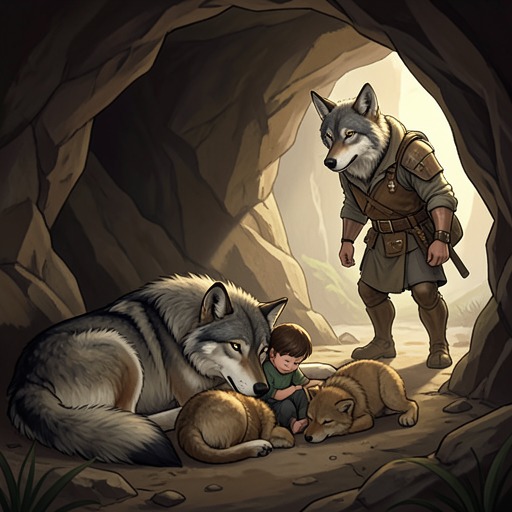
At the opening of Mowgli’s story, Father Wolf is preparing to hunt in the Seeonee hills after a day’s rest. At seven o’clock on a warm evening, he scratches himself, yawns, stretches his paws, and prepares to leave the cave where Mother Wolf lies with their four cubs. Tabaqui arrives at the entrance and offers an anxious, flattering greeting, but Father Wolf answers stiffly that there is no food in the cave. The exchange presents him as a guarded household protector, aware of the dangers surrounding his family and unwilling to let an intruder dictate the terms of the den.
Father Wolf’s household is already organized around the care of his own cubs when Mowgli appears. The baby is naked, brown, able only to walk, and bold enough to look up into a wolf’s face and laugh. Father Wolf picks him up with the same controlled gentleness used to move his cubs: his jaws close around the child’s back, but not a tooth scratches the skin. The action is both practical and defining. He recognizes the child as vulnerable, yet handles him as a member of the den rather than as prey.
Mother Wolf immediately notices that Mowgli pushes between the cubs toward the warm hide and eats beside them. Father Wolf observes that the child is hairless and could be killed with a touch of his foot, but he also notices that Mowgli looks up without fear. Mowgli’s fearlessness becomes the first sign that the strange child may belong among the wolves, while Father Wolf’s restraint becomes the first act of his guardianship.
Protection Against Shere Khan
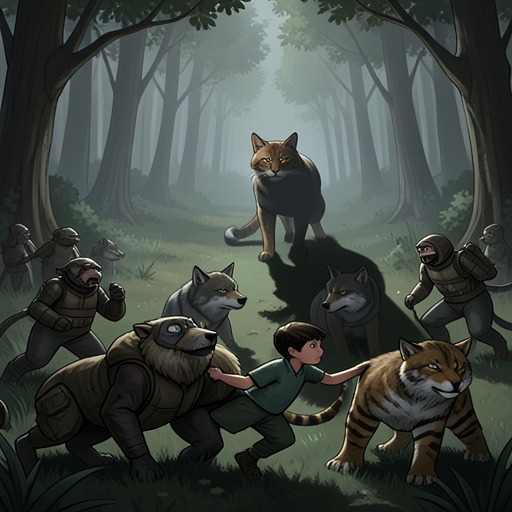
Father Wolf’s acceptance of Mowgli is tested by Shere Khan, who claims the right to the man-cub. The tiger’s demand threatens not only Mowgli but the integrity of the den: accepting the claim would mean surrendering a child who has already entered the wolf family. Father Wolf therefore becomes the immediate threshold guardian between the human child and the predator who wants him removed.
The decision is not represented as private sentiment alone. Father Wolf knows that the Pack will have to judge the child, and he asks what the Pack will say. The Jungle Law requires parents to bring their cubs before the Pack Council when they are old enough to stand, so that the other wolves can identify them. Once inspected, the cubs may run freely, and a grown wolf who kills one before it has killed its first buck is subject to death. Mowgli’s protection must therefore be carried from the den into a public legal and communal setting.
Presentation at Council Rock
Father Wolf waits until his cubs can run a little, then brings them, Mowgli, and Mother Wolf to Council Rock on the night of the Pack Meeting. The hilltop is covered with stones and boulders where a hundred wolves can hide. Akela lies on his rock as leader, while more than forty wolves gather below, ranging from experienced veterans able to handle a buck alone to young black wolves. The council’s quiet inspection makes membership a formal act rather than a simple domestic decision.
Akela repeatedly calls on the wolves to observe the Law and look carefully at every cub. Mothers push their cubs into the moonlight so that none is overlooked. When Father Wolf finally pushes Mowgli, called Mowgli the Frog, into the center of the circle, Mowgli sits laughing and playing with pebbles that glisten in the moonlight. Father Wolf’s gesture exposes his adopted child to judgment, but it also places him under the protection of the same communal law that guards the wolf cubs.
Baloo speaks for Mowgli, and Bagheera secures his acceptance by offering the price of a bull. Akela then orders Father Wolf to take the child away and train him as one of the Free People. This decision makes Father Wolf the practical agent of Mowgli’s incorporation. Mowgli enters the Seeonee Wolf Pack not by escaping the law but through its procedures, with Father Wolf’s family and the Pack’s institutions aligned around him.
Father Wolf as Teacher
After Mowgli’s adoption, Father Wolf teaches him the ordinary knowledge of jungle life. The narrative skips roughly ten or eleven years of this upbringing, but identifies Father Wolf as the one who teaches Mowgli his business and the meaning of things in the jungle. Under that instruction, every rustle in the grass, breath of warm night air, owl note, bat’s claws in a tree, and splash of a fish becomes legible to him.
This education gives Mowgli more than hunting skill. It makes the environment a system of signs and relations. Mowgli learns to read the jungle as Father Wolf reads it, while the domestic rhythms of sleeping, eating, swimming in forest pools, and living among the cubs form the background of his development. Although the wolf cubs mature into adult wolves before Mowgli is fully grown, Father Wolf’s teaching enables the human child to move within their world with unusual competence.
Baloo later gives Mowgli a broader formal education in the Law of the Jungle. He teaches the Wood and Water Laws, including how to distinguish a rotten branch from a sound one, speak politely to wild bees, address Mang the Bat, warn water-snakes before entering a pool, and use the Strangers’ Hunting Call when hunting beyond his own grounds. Father Wolf’s earlier instruction and Baloo’s systematic lessons together make Mowgli a child shaped by wolf family life and by the wider legal culture of the Jungle People.
Relationships and Narrative Role
Father Wolf’s central relationship is with Mowgli, whom he treats as both adopted child and member of the Pack. His care is bodily, immediate, and protective at the den; later it becomes educational, transmitting the knowledge needed for Mowgli to survive. With Mother Wolf, he forms the parental unit that absorbs Mowgli into an existing family of four cubs. Their shared response changes the human child from an intruder into a son within the cave.
His relationship with Akela is mediated by Pack authority. Father Wolf brings Mowgli before the leader and accepts the need for inspection, showing that parental protection operates within the Law rather than outside it. His relationship with Shere Khan is one of opposed claims: the tiger sees Mowgli as prey and a disputed possession, while Father Wolf treats him as a child whose place must be defended.
Father Wolf also represents the domestic and pedagogical side of the Free People. Akela provides leadership, Baloo provides explicit instruction, and Bagheera provides decisive advocacy, but Father Wolf supplies the first shelter, the first physical protection, and the long continuity of daily upbringing. His narrative function is therefore foundational rather than spectacular. He makes Mowgli’s later adventures possible by giving him a family, a language of the jungle, and a recognized place within its community.